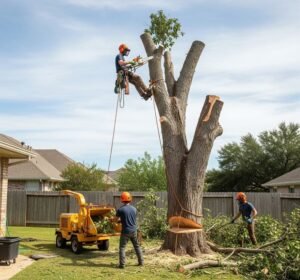
Tree removal is sometimes necessary when a tree becomes damaged, diseased, unstable, dead, or unsuitable for its location. Removing a tree is a specialized task that can involve climbing equipment, ropes, chainsaws, lowering systems, safety equipment, and trained workers. As a result, the final price can vary considerably from one property to another.
People researching tree removal cost, tree felling costs, or how much does it cost to remove a tree may find a wide range of prices online. This is because tree work is not usually priced using a single fixed rate. Tree height, trunk diameter, species, location, accessibility, condition, equipment, and disposal requirements can all affect the final quotation.
The terminology also varies between the USA and UK. In the United States, “tree removal” and “tree cutting services” are common terms, while “tree felling” is frequently used in the UK and other regions.
Understanding what contributes to the price can make tree removal estimates easier to evaluate.
What Is Tree Removal?
Tree removal involves taking down a tree and managing the resulting timber, branches, and other debris. Depending on the situation, the tree may be removed in one piece or dismantled section by section.
A straightforward tree in an open yard may be relatively simple to remove. A large tree located next to a house, power line, road, fence, or neighboring property can require considerably more planning.
Tree removal may be considered when a tree is:
- Dead or dying
- Structurally unstable
- Severely diseased
- Damaged by a storm
- Growing into a building
- Interfering with utility infrastructure
- Blocking access or visibility
- Causing significant property damage
- Located in an unsuitable or hazardous position
The condition of the tree is an important consideration because unstable trees can create additional safety risks during removal.
Tree Removal Cost
The tree removal cost depends primarily on the size and complexity of the job.
Small trees generally require less labor and equipment than mature trees. A large tree may require several workers, specialized climbing equipment, ropes, rigging systems, and additional time.
Other factors affecting cost include:
- Tree height
- Trunk diameter
- Tree species
- Number of branches
- Tree condition
- Location
- Access to the property
- Proximity to buildings
- Nearby power lines
- Required equipment
- Debris disposal
- Stump removal
- Local labor rates
Because these variables differ between properties, an on-site assessment is often necessary before a reliable price can be provided.
Average Cost of Tree Removal
The average cost of tree removal is often presented as a broad range rather than a fixed figure. Small residential trees can generally cost less to remove than large mature trees, while complex removals can cost substantially more.
A useful way to think about tree removal pricing is by project complexity:
| Tree Removal Situation | Typical Cost Considerations |
|---|---|
| Small tree in open yard | Lower labor and equipment requirements |
| Medium residential tree | Moderate cutting, climbing and cleanup |
| Large mature tree | More labor, equipment and disposal |
| Tree near a structure | Careful sectional removal may be required |
| Tree near utility lines | Additional planning and safety requirements |
| Storm-damaged tree | Urgency and unstable branches can increase complexity |
| Difficult-access tree | Specialized equipment or additional labor may be necessary |
| Tree plus stump removal | Additional grinding or excavation costs |
These categories are more useful than relying on one national average because actual tree removal prices vary by location and project conditions.
Tree Felling Costs
Tree felling costs refer to the expenses associated with cutting down a tree. The term “felling” generally describes bringing the tree down, while the broader removal process can include cutting, dismantling, hauling, cleanup, and stump work.
A tree may sometimes be felled in a controlled direction when there is sufficient open space. However, many residential properties do not provide enough room for a complete tree to be dropped safely.
In those situations, arborists or tree professionals may remove the tree in sections.
Branches are cut first, followed by sections of the trunk. Ropes and rigging systems can be used to lower pieces safely rather than allowing them to fall freely.
This additional work can affect the overall tree felling cost.
How Much Does It Cost to Cut Down a Tree?
The question “how much does it cost to cut down a tree?” cannot be answered accurately without considering the individual tree.
A short tree standing away from structures may require relatively basic equipment. A tall tree beside a home may need a climber, ground crew, ropes, rigging equipment, and specialized cutting techniques.
The cutting method also affects the price.
For example, a tree that can safely be felled in an open area may require less labor than one that must be dismantled piece by piece.
The cost of cutting down a tree can therefore include both the actual cutting work and the supporting activities required to complete the job safely.
Tree Size and Height
Tree size is one of the most important factors in pricing.
A tree’s height affects how difficult it is to access branches and control falling sections. Larger trees also contain more timber and branches that must be processed or removed.
Tree professionals may consider:
- Overall height
- Trunk diameter
- Crown spread
- Branch density
- Number of major limbs
- Tree lean
- Structural condition
A tall tree with a narrow trunk may present different challenges from a shorter tree with a very large trunk and extensive branches.
Tree Location and Accessibility
The location of a tree can have a major impact on tree removal prices.
An easily accessible tree in an open backyard may allow equipment to be positioned close to the work area.
By contrast, a tree located behind a house, inside a narrow garden, or beside a wall may require additional manual handling.
Difficult access can increase labor because workers may need to carry branches and equipment over longer distances.
Other challenging locations include trees near:
- Houses
- Garages
- Sheds
- Roads
- Fences
- Swimming pools
- Vehicles
- Utility lines
- Neighboring properties
The more controlled the removal needs to be, the more time and equipment may be required.
Tree Condition and Health
Healthy trees can still be difficult to remove, but dead or severely damaged trees may create additional hazards.
Dead wood can become brittle and unpredictable. Storm-damaged trees may have broken branches, split trunks, or unstable root systems.
Diseased trees can also require careful handling and disposal depending on the disease involved.
A tree professional may inspect the trunk, major branches, root area, and surrounding environment before determining an appropriate removal method.
Emergency Tree Removal
Storms, high winds, lightning, heavy snow, and other weather events can cause trees or large branches to fall unexpectedly.
Emergency tree removal may be required when a fallen or damaged tree blocks a driveway, damages a structure, or creates an immediate hazard.
Emergency work can have different pricing from scheduled tree removal because it may require rapid response, additional safety precautions, or work outside standard hours.
The condition of a storm-damaged tree can also make the work more complex than ordinary removal.
Tree Cutting Services Prices
Tree cutting services prices vary according to the type of work being performed.
Tree services may include:
- Tree removal
- Tree trimming
- Crown reduction
- Deadwood removal
- Branch removal
- Storm cleanup
- Tree pruning
- Stump grinding
- Hedge cutting
- Emergency tree work
- Tree inspections
It is important to distinguish between pruning and complete removal. Tree trimming involves selectively removing branches while retaining the tree. Tree removal involves taking down the entire tree.
These services require different levels of labor and equipment.
Stump Removal and Stump Grinding
Removing a tree does not necessarily mean that the stump will automatically be removed.
After the trunk and branches have been removed, the remaining stump can be ground below ground level using specialized equipment.
Stump grinding is usually priced separately from tree removal.
Complete stump extraction can involve more excavation because the roots may extend below the surface and across a large area.
Homeowners should therefore ask whether the quoted tree removal price includes:
- Stump grinding
- Stump removal
- Root removal
- Soil replacement
- Debris disposal
- Wood removal
A quotation that excludes these services may have a lower initial price but may not represent the complete project cost.
Tree Removal Prices in the USA
In the USA, tree removal prices vary substantially between states and metropolitan areas.
Labor costs, insurance requirements, local regulations, tree species, weather conditions, and property characteristics can all influence pricing.
Regions affected by hurricanes, severe storms, snow, or wildfire conditions may also experience periods of increased demand for tree services.
Local regulations can also affect removal requirements. Certain municipalities may have rules relating to protected trees, permits, public rights-of-way, or heritage trees.
Property owners should check applicable local requirements before removing a tree where regulations may apply.
Tree Removal Prices in the UK
The UK also has significant regional differences in tree removal prices.
The condition and location of the tree remain important factors, while local regulations can affect whether permission is required.
Some trees may be protected by a Tree Preservation Order (TPO) or may be located within a conservation area. In such circumstances, additional permissions or notifications may be required before work takes place.
Tree contractors in the UK may use terms such as tree surgeon, arborist, tree felling, crown reduction, and sectional dismantling.
The type of property and available access can also influence the cost.
Why Tree Removal Quotes Differ
Two companies may provide different quotes for the same tree because they may be including different services.
One quotation might include:
- Cutting
- Branch removal
- Trunk removal
- Cleanup
- Stump grinding
Another quotation might cover only the tree cutting itself.
When comparing tree removal prices, it is therefore important to check the scope of work.
Questions worth asking include:
- Is the full tree being removed?
- Are branches and logs included?
- Is cleanup included?
- Is stump grinding included?
- Are disposal fees included?
- Is specialized equipment required?
- Are permits included where applicable?
- Is emergency work charged differently?
A detailed written quotation can help prevent misunderstandings.
Insurance and Professional Tree Work
Tree removal involves chainsaws, heavy branches, climbing equipment, and potentially unstable structures. The work can therefore create significant risks to people and property.
For larger or complex trees, homeowners may want to verify that the contractor has appropriate insurance and relevant professional qualifications.
In the USA, arborists may hold credentials from organizations such as the International Society of Arboriculture (ISA). In the UK, tree professionals may have qualifications associated with arboriculture and industry organizations such as the Arboricultural Association.
Credentials do not determine the price, but they can help homeowners understand the contractor’s professional background.
How Much to Remove a Tree?
The question “how much to remove a tree?” ultimately depends on the tree and its surroundings.
A simple removal may involve limited cutting and cleanup. A complex removal can involve climbing, rigging, specialized machinery, traffic management, utility coordination, and extensive debris handling.
The best way to establish a project-specific cost is to have the tree assessed and receive a detailed quotation describing the work included.
Final Thoughts on Tree Removal Cost
Tree removal cost is influenced by much more than the height of a tree. Size, species, condition, location, accessibility, nearby structures, equipment requirements, labor, disposal, and stump work can all affect the final price.
When researching how much does it cost to remove a tree, tree felling costs, or tree cutting services prices, broad averages can provide context, but they should not be treated as an exact quotation.
Homeowners in the USA and UK should also consider local regulations, particularly where protected trees, conservation areas, utility lines, or public spaces are involved.
A detailed estimate should identify the tree being removed, the removal method, cleanup arrangements, stump services, disposal requirements, and any additional work.
Understanding these factors makes it easier to interpret tree removal prices and compare quotations based on the complete scope of the work rather than a single headline figure.