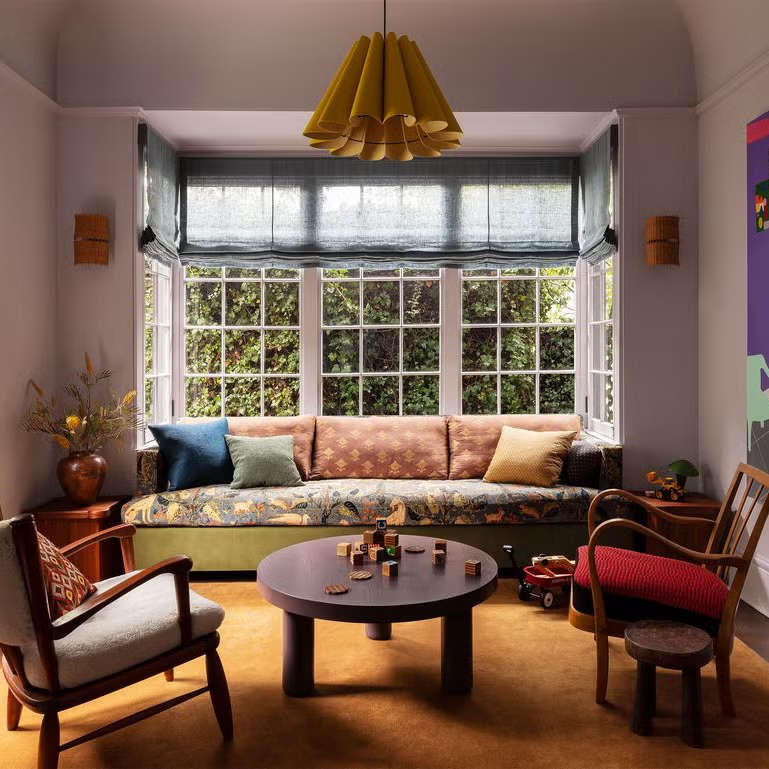
Across the landscapes of the United Kingdom and the United States, the built environment tells a story of time, culture, and craftsmanship. Every era, material, and movement has left its mark in the form of architecture — shaping the way people live, think, and connect with their surroundings. When we talk about the styles of houses, we are exploring more than structure and aesthetics; we are exploring identity, innovation, and history.
From centuries-old cottages and Georgian terraces in the UK to Victorian, Colonial, and Mid-Century homes in the USA, each house style reflects social progress, technology, and design philosophy. Understanding different house styles gives us insight into the evolution of architecture and how our homes have adapted to lifestyle changes over time.
This article delves into the types of house styles across history and geography, exploring how architecture evolved from traditional craftsmanship to modern-day innovation while remaining rooted in cultural expression.
The Meaning Behind House Styles
The term house style refers to the overall design language and architectural characteristics of a home — including structure, materials, roof shapes, windows, layout, and ornamentation.
Different styles of houses often originate from a specific period, region, or design movement. Each reflects the cultural priorities of its time — whether it’s symmetry and grandeur in Georgian homes, decorative detail in Victorian architecture, or simplicity and openness in contemporary design.
Recognizing the types of house styles helps homeowners, architects, and historians connect the dots between history, lifestyle, and design evolution.
Styles of Houses Through History
Architecture has evolved alongside civilization. From early timber cottages to sleek glass structures, the style of home builds throughout history showcases human creativity responding to climate, culture, and available materials.
1. Medieval and Tudor Houses (Pre-17th Century, UK)
In Britain, medieval homes were often timber-framed with thatched roofs and wattle-and-daub walls. By the 15th and 16th centuries, Tudor houses emerged — recognizable by their steeply pitched roofs, exposed wooden beams, and tall, narrow windows with leaded glass.
These early house styles prioritized function over symmetry, blending practicality with rustic charm. Surviving examples can still be found in English towns like Stratford-upon-Avon.
2. Colonial and Early American Homes (17th–18th Century, USA)
Across the Atlantic, settlers brought European influences, adapting them to local conditions. The Colonial style — one of the earliest American house styles — emphasized symmetry, central chimneys, and gabled roofs.
Subtypes included:
-
Dutch Colonial: Featuring gambrel roofs and flared eaves.
-
Spanish Colonial: Common in the Southwest, using stucco walls and red-tiled roofs.
-
Georgian Colonial: Reflecting British Georgian influence with balanced façades and classical details.
These types of houses styles laid the foundation for America’s architectural diversity.
Georgian and Federal Styles: Symmetry and Proportion
Georgian Style (1714–1830, UK & Colonial America)
Named after the reigns of Britain’s King Georges, Georgian houses were defined by order and proportion. They featured brick façades, sash windows, decorative doorways, and symmetrical layouts.
In cities like Bath and Edinburgh, terraced Georgian homes became a hallmark of British urban architecture. Across the Atlantic, Colonial Georgian houses followed similar principles, with added American touches such as wood cladding instead of brick.
Federal Style (1780–1840, USA)
The Federal style, sometimes considered America’s first native adaptation, evolved from Georgian architecture but incorporated more refined and delicate detailing. Oval rooms, elliptical fanlights, and slim columns were common features, symbolizing the optimism of the new American Republic.
These styles reflected the Enlightenment’s influence — rational, balanced, and refined.
Victorian and Gothic Revival: Ornament and Industrial Progress
The Victorian era (1837–1901) marked rapid industrialization and expanding middle-class prosperity in both the UK and the USA. Architecture reflected this diversity and experimentation, leading to an array of different house styles under one umbrella.
Victorian Style (19th Century, UK & USA)
Victorian houses are known for their decorative complexity — intricate woodwork, patterned brick, stained glass, and steep gables. Variants include:
-
Gothic Revival: Pointed arches, lancet windows, and ornate details inspired by medieval cathedrals.
-
Italianate: Overhanging eaves with brackets and tall, narrow windows.
-
Queen Anne: Asymmetrical façades, turrets, and vibrant colours — especially popular in American cities like San Francisco.
In the UK, terraced Victorian homes became standard in cities like London, Manchester, and Birmingham — compact yet full of decorative character.
These types of house styles represented a celebration of craftsmanship during a time of industrial change.
Edwardian and Arts & Crafts: Simplicity Returns
As the ornate exuberance of the Victorian age faded, the early 20th century introduced a move toward simplicity, balance, and natural materials.
Edwardian Style (1901–1914, UK)
The Edwardian house style reflected a lighter, airier approach compared to its Victorian predecessor. Homes featured red brick, bay windows, wider hallways, and decorative yet restrained woodwork. Large porches and patterned tiling were also common.
Arts & Crafts Movement (1880–1920, UK & USA)
Influenced by designers like William Morris, this style emphasized handcrafted quality over mass production. Exposed beams, built-in furniture, and an appreciation of natural materials defined the aesthetic.
In the USA, Craftsman-style homes — particularly the California Bungalow — became a direct continuation of this movement, combining function, beauty, and honesty in materials.
These different styles of houses represent the human response to industrialization — a desire to reconnect design with nature and authenticity.
20th Century Modernism: Function and Innovation
The 20th century brought profound architectural change. Advances in technology, new materials, and global influences gave rise to diverse types of house styles characterized by innovation and minimalism.
1. Prairie Style (1900–1920, USA)
Pioneered by architect Frank Lloyd Wright, Prairie homes were designed to blend with the landscape. They featured low-pitched roofs, horizontal lines, and open floor plans — a radical departure from closed Victorian interiors.
2. International Style (1920s–1940s, Europe & USA)
Defined by simplicity and function, the International style embraced glass, steel, and concrete. Boxy shapes, flat roofs, and open spaces prioritized utility over ornamentation.
3. Mid-Century Modern (1945–1970, USA & UK)
After World War II, suburban growth and optimism shaped the Mid-Century Modern aesthetic. Hallmarks included large windows, clean lines, and seamless indoor-outdoor connections.
Famous examples include the Case Study Houses in California and postwar British housing developments inspired by similar principles.
These different style homes embodied progress — architecture that celebrated modern life, efficiency, and connection with nature.
Regional and Vernacular Styles
While global design movements influenced architecture, local traditions and climates also shaped unique house styles across regions.
United Kingdom Regional Styles
-
Cottage Style: Found in rural areas with stone or brick walls, thatched or slate roofs, and cozy interiors.
-
Terraced Houses: Common in urban areas, offering efficient land use with shared walls.
-
Victorian Villas: Semi-detached suburban homes with bay windows and ornamental brickwork.
United States Regional Styles
-
Cape Cod: Simple, steep-roofed houses with dormer windows, originally built by early settlers in New England.
-
Ranch Style: Single-story homes with open layouts, popular in postwar America.
-
Spanish Revival: Stucco walls, arches, and terracotta roofs inspired by Mediterranean heritage, especially in California.
-
Southern Colonial: Tall columns, large porches, and symmetry reflecting 18th-century plantation architecture.
Regional types of house styles highlight how geography and culture intersect in the built environment.
Postmodernism and Contemporary Design
The latter half of the 20th century saw a reaction to the strict simplicity of modernism. Architects began reintroducing ornament, playfulness, and historical references into their designs.
Postmodern Style (1970s–1990s)
Characterized by bold colours, eclectic forms, and whimsical details, postmodern homes combined elements from various periods. They rejected uniformity and celebrated individuality.
Contemporary and Sustainable Homes (2000–Present)
Modern-day house styles focus on sustainability, technology, and adaptability. Key features include:
-
Open floor plans and flexible living spaces.
-
Energy-efficient systems and eco-friendly materials.
-
Minimalist aesthetics with emphasis on natural light.
-
Integration of smart home technology.
The contemporary style of home builds throughout history reflects changing priorities — from visual grandeur to environmental responsibility.
Comparing UK and USA House Styles
Though the UK and USA share architectural influences, their housing landscapes differ due to history, culture, and urban development patterns.
| Feature | United Kingdom | United States |
|---|---|---|
| Historic Influences | Tudor, Georgian, Victorian, Edwardian | Colonial, Federal, Victorian, Mid-Century |
| Common Materials | Brick, stone, slate | Wood, brick, stucco |
| Urban Typologies | Terraced and semi-detached homes | Detached single-family houses |
| Design Evolution | Compact, efficient layouts | Spacious, open-plan designs |
| Current Trends | Modern conversions, sustainable retrofits | Smart homes, energy-efficient builds |
Despite these differences, both countries exhibit a shared architectural journey — adapting tradition to meet modern needs while preserving historical identity.
Architectural Elements That Define House Styles
Every house style can be identified by distinct design elements. Understanding these helps classify different styles of houses at a glance.
-
Roof Shape: Gabled, hipped, flat, or mansard roofs vary by region and era.
-
Windows: Georgian sash windows differ from the expansive glass panes of modern homes.
-
Materials: From timber and stone to concrete and glass, materials evolve with technology.
-
Symmetry: Classical and Colonial designs emphasize balance, while modern homes often favour asymmetry.
-
Details: Ornamentation, trim, and colour schemes help define a home’s personality.
These elements together express the architectural language that distinguishes types of house styles across centuries.
Urban and Rural Expressions of Home Design
Architecture adapts to its context — a house style that fits a countryside setting may differ significantly from its urban counterpart.
Rural Homes
In rural England or the American Midwest, houses often use local materials and traditional forms to harmonize with the landscape. Cottage, farmhouse, and ranch styles dominate, emphasizing comfort and practicality.
Urban Homes
City homes focus on space efficiency and vertical design. Terraced houses in the UK and brownstones or townhouses in US cities like Boston and New York exemplify elegant urban living within compact footprints.
This contrast between rural and urban housing illustrates how different style homes evolve to meet distinct environmental and cultural needs.
The Influence of Technology on Modern House Styles
Technology continues to shape how we design and live in homes. Innovations in construction, materials, and energy systems redefine the boundaries of house styles today.
-
Prefabrication and Modular Design: Modern houses can be assembled off-site, reducing waste and construction time.
-
Smart Homes: Automation, energy monitoring, and climate control create responsive living environments.
-
Green Architecture: Solar panels, green roofs, and passive design reduce environmental impact.
-
Adaptive Reuse: Converting old buildings into modern homes preserves history while embracing sustainability.
These trends signal a new era in the style of home builds throughout history — one where efficiency and sustainability are as valued as beauty.
Cultural and Emotional Connections to House Styles
Beyond architecture, house styles reflect cultural values and emotional connections. A Victorian home evokes nostalgia; a minimalist modern house symbolizes progress.
People often choose homes that resonate with their identity — traditionalists may favour symmetrical Georgian facades, while modernists lean toward glass-walled contemporary spaces.
This emotional dimension explains why different styles of houses continue to coexist — architecture, after all, is as much about people as it is about buildings.
The Future of House Styles
As the world faces new challenges — from climate change to urban density — future types of house styles will continue to evolve. Trends suggest a move toward:
-
Sustainability and Resilience: Homes that adapt to environmental changes.
-
Compact Design: Efficient layouts for smaller urban living.
-
Cultural Fusion: Blending traditional craftsmanship with modern materials.
-
Community-Oriented Spaces: Shared courtyards and co-living developments.
Just as Tudor timber frames and mid-century steel beams once symbolized progress, future homes may be defined by their ability to conserve energy, connect digitally, and coexist harmoniously with nature.
Conclusion: The Living Story of House Styles
From medieval cottages to smart eco-homes, the styles of houses tell an evolving story of humanity’s relationship with shelter, society, and self-expression. Each house style — whether Georgian, Colonial, Victorian, or Modernist — reflects a moment in time, a cultural value, or a technological leap forward.
In both the UK and USA, these different styles of houses continue to evolve while preserving the essence of history. Understanding the types of house styles allows us to appreciate architecture not just as construction, but as living history — a mirror of the people, places, and ideas that built it.
Every home, regardless of its size or age, is part of this ongoing narrative. Together, these structures form a mosaic of human creativity — a story built brick by brick, style by style.