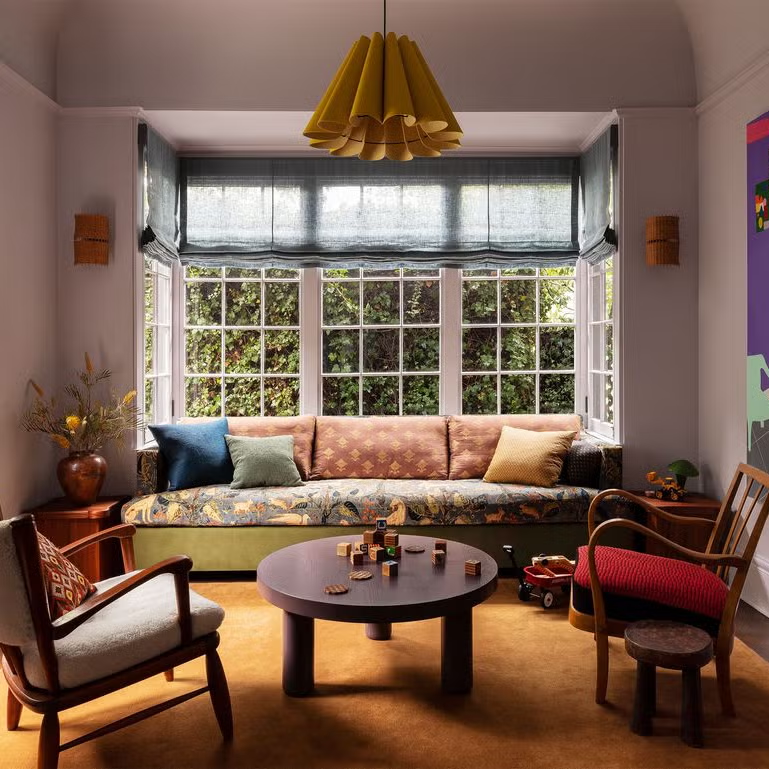
Across centuries and continents, few ancient philosophies have influenced architecture, design, and human well-being as profoundly as Feng Shui. Often misunderstood or simplified as interior decoration advice, this deeply rooted practice represents far more — a philosophy that harmonises humans with their surroundings through energy balance, spatial orientation, and environmental awareness.
Commonly spelled as feng shui, fu shui, fung shui, fenshai, or even fengshui, this concept originates from traditional Chinese cosmology and has been embraced globally, including in homes, offices, and urban planning across the UK and USA.
This article explores the true feng shui definition, its principles, cultural origins, and continued relevance in contemporary life, while demystifying the variations of the term — from fung shway to feng sui — that have appeared as it journeyed across languages and cultures.
Defining Feng Shui: Meaning and Origins
To define feng shui, one must first understand its linguistic and philosophical foundation. In Mandarin Chinese, “feng shui (風水)” literally translates to “wind and water.” These two natural elements symbolise the invisible yet powerful forces that shape life and the environment.
Wind represents movement, communication, and the flow of energy (known as qi or chi), while water symbolises abundance, adaptability, and nourishment. Together, they embody the continuous flow of energy that connects all things — human, natural, and spiritual.
Feng shui definition:
A traditional Chinese practice based on arranging and orienting spaces in harmony with the natural flow of energy (qi), to promote balance, health, and prosperity.
This philosophy is not a superstition or religion, but rather a system of environmental harmony, blending astronomy, geography, architecture, and psychology.
Historical Roots: The Birth of Feng Shui
The origins of fengshui date back more than 3,000 years to ancient China, where it developed from early practices of geomancy — the interpretation of land and energy patterns. Farmers, builders, and scholars studied the flow of winds, rivers, and sunlight to determine the best places for villages, homes, and burial sites.
During the Zhou and Han dynasties, feng shui became formalised into a structured discipline. Early practitioners were known as feng shui masters, experts who combined observation, mathematics, and astronomy to align human settlements with the Earth’s natural rhythms.
Over time, feng shui evolved into various schools of thought, each emphasising different aspects of orientation, energy flow, and symbolic interpretation. These classical schools continue to influence contemporary design, both in the East and in Western countries such as the UK and USA.
The Core Principles of Feng Shui
While there are many interpretations and variations — sometimes written as feng sui, feng shue, or fung shway — the foundation of feng shui rests on several core concepts:
-
Qi (Chi): The life force or energy that flows through all things. Proper feng shui seeks to maintain smooth, balanced qi in both interior and exterior spaces.
-
Yin and Yang: The duality of nature — opposite yet complementary forces (e.g., light and dark, active and passive) that must coexist harmoniously.
-
The Five Elements: Wood, Fire, Earth, Metal, and Water — symbolic components that represent natural cycles and interactions.
-
The Bagua Map: A geometric energy map that divides spaces into eight areas, each associated with aspects of life such as wealth, health, family, and knowledge.
-
Balance and Flow: The physical arrangement of furniture, architecture, and pathways to ensure that energy moves freely without obstruction.
These principles guide both traditional and modern interpretations of feng shui, shaping architecture, landscaping, and interior design across cultures.
Feng Shui and the Environment
At its heart, feng shui is an environmental philosophy. It recognises that surroundings influence emotional well-being, decision-making, and even physical health.
For instance, the placement of a building relative to mountains, rivers, or roads affects how qi moves through a landscape. In ancient China, ideal sites for villages faced south — symbolising warmth and light — with mountains behind for protection and water in front for abundance.
Modern applications follow the same logic, whether it’s situating a home near green spaces in London or designing an open-plan office in New York to promote collaboration and airflow.
By aligning structures with natural features, fengshui seeks not to control nature but to coexist harmoniously within it.
Feng Shui in Architecture and Urban Planning
Throughout history, feng shui has influenced the placement and design of cities, palaces, and homes. The Forbidden City in Beijing, for example, was constructed based on strict feng shui alignment — with gates, courtyards, and halls arranged along a central north-south axis symbolising balance and authority.
In modern times, architects and urban planners in both the UK and USA draw inspiration from feng shui principles when designing sustainable and psychologically supportive spaces. Concepts like natural light, airflow, and biophilic design echo feng shui’s emphasis on human-environment harmony.
London’s urban parks and open squares, or New York’s grid balanced with green spaces, reflect an unconscious parallel to fu shui ideals — ensuring that energy (and people) circulate freely.
The Global Spread of Feng Shui
As trade and migration expanded, feng shui travelled far beyond China’s borders. It entered Japan, Korea, and Southeast Asia, each adapting the principles to their local cultures. By the 20th century, it had reached the Western world, particularly the USA, where it became popular in both domestic and corporate environments.
In the UK, feng shui gained attention during the 1980s and 1990s alongside the rise of holistic design and sustainable architecture. Although sometimes mispronounced as fung shway or fenshai, the essence of the philosophy remained intact — balance, flow, and spatial awareness.
Today, many designers, real estate developers, and homeowners integrate feng shui-inspired ideas, whether consciously or intuitively, to enhance comfort and functionality in built spaces.
Feng Shui and the Human Mind
While feng shui is often associated with physical layouts, its influence extends deeply into psychology. The arrangement of space affects how people think, feel, and behave.
For example:
-
Cluttered environments can create mental stress, obstructing the flow of energy and focus.
-
Balanced lighting and symmetrical design promote calmness and clarity.
-
Natural elements, such as plants and water features, foster relaxation and vitality.
This connection between physical surroundings and emotional health aligns feng shui with modern psychological and architectural theories — especially those related to environmental psychology and wellness design.
In both British and American workplaces, these principles contribute to the development of calming, productive spaces — echoing the age-old tenets of feng sui.
The Five Elements in Feng Shui Philosophy
A central theme in feng shui is the interaction of the Five Elements — Wood, Fire, Earth, Metal, and Water. Each represents natural forces and emotional qualities:
-
Wood symbolises growth, flexibility, and creativity.
-
Fire represents energy, transformation, and passion.
-
Earth stands for stability, balance, and nourishment.
-
Metal embodies clarity, logic, and strength.
-
Water reflects adaptability, flow, and wisdom.
These elements interact through cycles of creation and control. For instance, Water nourishes Wood, Wood fuels Fire, Fire creates Earth (ash), Earth produces Metal, and Metal enriches Water. Maintaining harmony among these cycles ensures balanced energy — a concept fundamental to all schools of fengshui.
The Bagua: Mapping Energy in Space
The Bagua map is a key tool in feng shui practice. This eight-sided diagram divides a space into zones corresponding to specific life areas, such as health, career, relationships, and prosperity.
Each section of the Bagua relates to one of the Five Elements and carries symbolic meaning:
-
North: Career and life path (Water element)
-
South: Fame and recognition (Fire element)
-
East: Family and health (Wood element)
-
West: Creativity and children (Metal element)
-
Centre: Balance and overall well-being (Earth element)
While classical feng shui uses compass directions to align the Bagua, Western adaptations focus more on personal intention and emotional flow.
This adaptability has helped feng shui thrive in modern contexts — from London flats to Los Angeles offices — showing its universality beyond cultural boundaries.
Misunderstandings and Misrepresentations
Over time, Western interpretations of feng shui have sometimes simplified or distorted its depth. Popular media often equates it with decorative tips or lucky charms, overlooking its philosophical and ecological roots.
For example, the phrase fung shway, though widely used in English-speaking countries, often accompanies oversimplified notions like “place a plant for good luck.” While plants indeed represent vitality in feng shui, their true significance depends on balance, placement, and context.
Similarly, fu shui or feng shue are alternate spellings that reflect phonetic adaptations rather than conceptual differences. Regardless of the name, the practice remains grounded in observation, harmony, and mindfulness rather than superstition.
Feng Shui in Modern Living
Despite evolving interpretations, the principles of feng shui continue to resonate in modern design philosophies.
In the UK, where architectural heritage meets innovation, feng shui concepts merge naturally with sustainability and well-being design — evident in open layouts, natural ventilation, and daylight optimisation.
In the USA, feng shui often intersects with minimalist and biophilic design trends, promoting interiors that reduce stress and connect occupants to nature. Companies integrate energy-conscious design not as ritual but as functional science — echoing the feng sui balance between human intention and environment.
The enduring appeal of feng shui lies in its universal truth: the spaces we inhabit reflect and shape our inner lives.
Academic and Scientific Perspectives
In recent decades, scholars have examined feng shui through lenses of environmental psychology, physics, and cultural studies. Some studies suggest that its effectiveness stems not from mysticism but from practical design logic — optimising air flow, light exposure, and spatial balance.
Architects and urban planners often acknowledge feng shui’s intuitive wisdom, even when detached from its metaphysical roots. The practice’s emphasis on balance and flow aligns with sustainable architecture, ergonomic design, and human-centred environments.
Thus, the definition of feng shui extends beyond its Chinese origins, encompassing both ancient philosophy and modern science.
Cultural Interpretations and Adaptations
Across the world, feng shui takes on local characteristics. In the UK, it intersects with European traditions of geomancy and landscape alignment — evident in ancient sites like Stonehenge that share similar spatial consciousness.
In the USA, feng shui merges with contemporary spirituality and wellness culture. Its focus on mindful living aligns with trends like meditation, holistic health, and sustainable home design.
Even within Asia, variations exist:
-
In Japan, related practices such as fusui combine Shinto and Buddhist influences.
-
In Southeast Asia, feng shui blends with local animist and architectural traditions.
These adaptations show that feng shui is not static but evolves alongside cultural needs while maintaining its central theme of harmony.
The Linguistic Journey: Feng Shui and Its Variants
As feng shui spread globally, pronunciation and spelling adapted across languages:
-
Feng Shui: The standard transliteration from Mandarin (Pinyin).
-
Fengshui: The combined form often used in academic writing.
-
Feng Sui / Feng Shue: Common Western misspellings or phonetic adaptations.
-
Fu Shui / Fenshai / Fung Shway: Variations influenced by Cantonese or English pronunciation.
Regardless of spelling, all refer to the same practice rooted in environmental harmony and spatial awareness. This linguistic diversity reflects the philosophy’s global integration and cultural adaptability.
The Enduring Legacy of Feng Shui
Despite centuries of social and technological change, feng shui endures because it speaks to a universal human desire — to live in balance with one’s surroundings. Whether viewed as cultural heritage, environmental wisdom, or psychological insight, its message remains timeless.
In architecture, it reminds designers that buildings must breathe with the earth. In daily life, it encourages mindfulness of how space affects mood and energy. And in broader culture, it continues to bridge East and West, ancient and modern.
From Beijing’s imperial palaces to London apartments and Los Angeles studios, the philosophy of feng shui continues to flow — like the wind and water it is named for.
Conclusion: Feng Shui as a Living Philosophy
The enduring power of feng shui lies in its simplicity and universality. It does not demand belief in mysticism but awareness of how energy, balance, and environment influence human life.
To define feng shui is to recognise it as a living philosophy — a conversation between nature and humanity that transcends geography and time.
Whether called fung shway, fu shui, feng sui, or fenshai, it speaks the same truth: harmony is the foundation of health, prosperity, and peace.
Across the UK and USA, as in the rest of the world, this ancient art continues to shape not only buildings but also the way people experience the spaces they call home.